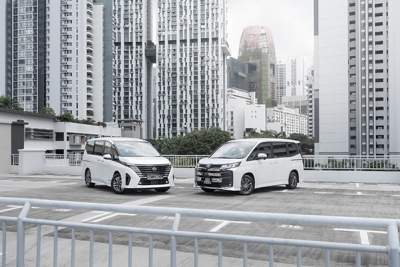
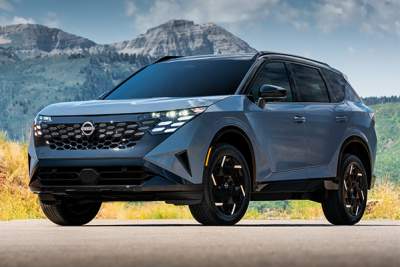
There should be no lingering doubts about how the Koreans have progressed massively since their inceptions, and have inched dangerously close to the Japanese.
Once only known for their sheet metal appeal, they too are gaining grounds in technological field. Gone were the days where the lumps at the front sounded like industrial blocks, with stomach grouching cog swops to match.
Nowadays, one will not have to look hard to find 'comfort' and 'refinement' in the Koreans' books.
No wonder, then, these breed of cars are able to command prices close to or even superseding the Japanese. At the time we sampled the Elantra, it retails at $111,999, whereas the latest Sylphy costs a puny less at $106,800. Exterior
The Elantra feels like a genuine 'designers' product'. Despite having been in the market for a couple of years now, the Elantra's styling hasn't staled at all. Swarmed with lovely, vivid curves, the Elantra makes its rivals pale in terms of lasting looks.
In contrast the Sylphy's styling is less attention-seeking. It looks little like its predecessor, and we would go as far as saying it looks much better than before.
Like what it was designed to do, the Sylphy accentuates more sophistication - from its easy-on-the-eye contours to wearing of chromed bits and its multi-spoke rims tastefully done in two contrasting tones.
The Sylphy's clean outfit may not be as stunning to look at as the Elantra, but will no doubt earn its keep with its sombre character.Like what it was designed to do, the Sylphy accentuates more sophistication - from its easy-on-the-eye contours to wearing of chromed bits and its multi-spoke rims tastefully done in two contrasting tones.
Interior
The Elantra's flair for style is further expressed in its interior. Like its sheet metal, the dashboard adorns curves with conviction, coupled with a bluish hue backlight that looks both unique and pleasant to the eye.
There are, however, rooms for improvement in terms of cabin quality. It is not uncommon to see tacky bits and plastic trims which are cheap to the feel.
The Sylphy, on the other hand, adopts a straight-to-point, fuss free approach to its interior design. Climatorial and audio controls are nicely positioned and easy to use. While it isn't as visually appealing as the Elantra's, it charms in better quality and simplicity. However, as a daily driver, the Sylphy could have done with more cubby holes up front for handphones and wallets.
It is no surprise that both sedans are carved ideally to transport five in comfort. The Elantra has better shoulder room, but lacks in areas of head and leg room when pit against the Sylphy. As a result, the latter is more comfortable to be in, with credits to its roomier quarters and supportive rear seats.
It is no surprise that both sedans are carved ideally to transport five in comfort. The Elantra has better shoulder room, but lacks in areas of head and leg room when pit against the Sylphy. As a result, the latter is more comfortable to be in, with credits to its roomier quarters and supportive rear seats.
The Drive
The Sylphy inherits a 1.6-litre block from its Juke counterpart. Put through the paces, the Sylphy feels more eager, with a more responsive throttle and a chassis that feels light on its feet.
The Elantra, on the other hand, feels heavier and planted. Although the Korean workhorse pushes out 14 more horses than its Japanese rival, the gain on paper somehow does not actualise on the road.
In terms of handling, it is the Elantra which will please the more discerning motorists. While both sedans will never make the mark as 'best-to-drive', those looking for a more involving drive will be satisfied with the Korean's more weighted steering.
Adding to the driving involvement is the Elantra's six-speed automatic gearbox, which is just as eloquent in smooth gear changes without the 'muted' experience as with the CVT in the Sylphy.
On the run, both sedans proved to be an effective and pleasant commute, especially so for the Sylphy which has a slight edge in terms of cabin insulation.
Driven economically, both sedans will fare well, with the Sylphy bringing home close to 14km/L and the Elantra managing 13km/L.
Conclusion
Despite their disparity in origins, both cars come very close in terms of value-for-money, while posing different appeals. The Elantra is a looker, coupled with the more engaging drive which will add the extra bit of spice in your daily commute.
The Sylphy, on the other hand, charms with genuine practicality, providing occupants with an extra bit of grin with the sumptuous allowances and cabin comfort.
In all areas, these cars couldn't have been more closely matched. The only difference, at this point in time, is the cost of both cars - which is only some $5,000 apart.